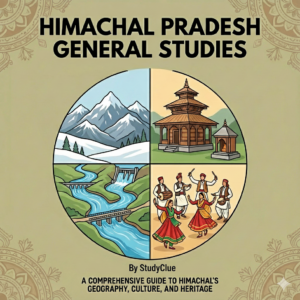
The Himachal Pradesh General Studies Book is a comprehensive and exam-focused resource designed for candidates preparing for HPAS, HPSSC, HP Police, HP TET, JOA, and other state-level competitive examinations. The book provides accurate, updated, and well-organized information covering the geography, history, culture, economy, society, administration, and environment of Himachal Pradesh.
Structured into thirteen major chapters, the book ensures systematic learning, topic-wise clarity, and ease of revision. It is intended to help learners develop strong conceptual understanding and factual command essential for competitive exam success.
Table of Contents
Chapter 1: Geography of Himachal Pradesh
Chapter 2: Historical Background of Himachal Pradesh
Chapter 3: Formation and Administrative Evolution
Chapter 4: People and Society
Chapter 5: Art, Culture and Heritage
Chapter 6: Economy of Himachal Pradesh
Chapter 7: Transport, Communication and Infrastructure
Chapter 8: Governance and Political System
Chapter 9: Education and Health
Chapter 10: Flora, Fauna and Environment
Chapter 11: Tourism and Attractions
Chapter 12: Important Personalities and Achievements
Chapter 13: Miscellaneous Information
Indian Geography
Basic Indian Geography is a comprehensive and learner-friendly guide designed to help students understand India’s diverse physical, cultural, and environmental landscape. The book covers the fundamentals of geography, India’s geological structure, major landforms, climate systems, drainage patterns, natural resources, population dynamics, and economic activities. It provides simplified explanations, clear concepts, and structured topics useful for school and college students, competitive exam aspirants, and anyone interested in understanding India’s geographical identity.
Each unit builds conceptual clarity through concise content, factual insights, and India-specific examples. The book also includes sections on disaster management, important geographical facts, and quick-revision tools to support exam preparation.
Units Included
Unit 1: Introduction to Geography
Unit 2: Physical Setting of India
Unit 3: Geological Structure of India
Unit 4: The Northern Mountains
Unit 5: The Northern Plains
Unit 6: The Peninsular Plateau
Unit 7: The Indian Desert
Unit 8: Coastal Plains of India
Unit 9: Islands of India
Unit 10: Climate of India
Unit 11: Drainage System of India
Unit 12: Soil Resources of India
Unit 13: Natural Vegetation & Wildlife
Unit 14: Agriculture in India
Unit 15: Mineral & Energy Resources
Unit 16: Industries of India
Unit 17: Population and Human Geography
Unit 18: Transportation & Communication
Unit 19: Natural Hazards & Disaster Management
Unit 20: India – Important Geographical Facts (Exam Booster)

English Grammar
This book provides a comprehensive and easy-to-understand foundation in English grammar, designed for students, competitive exam aspirants, and anyone wishing to strengthen their language skills. Beginning with the basics of grammar and sentence structure, it guides learners through all essential components of the English language—parts of speech, tenses, voice, narration, modals, subject–verb agreement, and more.
The book also covers vocabulary building, punctuation rules, error detection, and core writing skills such as essays, letters, reports, and dialogue writing. With a focus on clarity, examples, and practical usage, it helps learners improve accuracy and fluency in both written and spoken English. The final section includes practice exercises, previous-year question patterns, and mock tests to reinforce learning and ensure exam readiness.
Units Included in the Book
Unit 1: Foundations of English Grammar
Unit 2: Parts of Speech
Unit 3: Articles & Determiners
Unit 4: Tenses
Unit 5: Voice and Narration
Unit 6: Sentence Structure
Unit 7: Modals & Auxiliary Verbs
Unit 8: Subject–Verb Agreement
Unit 9: Vocabulary Essentials
Unit 10: Punctuation & Capitalization
Unit 11: Error Detection & Correction
Unit 12: Writing Skills
Unit 13: Reading Comprehension
Unit 14: Practice Section
Indian History
“Basic Indian History” offers a concise yet comprehensive overview of India’s historical evolution—from prehistoric cultures to modern nation-building. The book introduces the meaning, scope, and significance of history, along with the key archaeological and literary sources that shape our understanding of India’s past.
It traces major historical phases—Ancient, Medieval, and Modern India—highlighting how geography, societal changes, and political developments influenced the growth of Indian civilization. Beginning with early human settlements, it explores the Indus Valley Civilization, the transformations of the Vedic Age, and the rise of early states and empires, including the Mahajanapadas, Mauryas, and Guptas.
The narrative then moves through the early medieval powers, the establishment of the Delhi Sultanate and Mughal Empire, and the emergence of significant regional states. The arrival of Europeans, expansion of British rule, and key events such as the Revolt of 1857 and the Indian National Movement are presented clearly and cohesively.
The book concludes with the developments of post-Independence India and a rich overview of Indian art, culture, and heritage, providing learners with a solid foundation and holistic understanding of India’s historical journey.
📑 Unit Names
Unit 1: Introduction to Indian History
Unit 2: Prehistoric India
Unit 3: Indus Valley Civilization (Harappan Culture)
Unit 4: Vedic Age
Unit 5: Mahajanapadas and Rise of States
Unit 6: Religious Movements (6th Century BCE)
Unit 7: Mauryan Empire
Unit 8: Post-Mauryan Period
Unit 9: Gupta Empire (Golden Age of India)
Unit 10: Post-Gupta Period
Unit 11: Early Medieval India
Unit 12: Delhi Sultanate
Unit 13: Mughal Empire
Unit 14: Regional States after the Mughals
Unit 15: Advent of Europeans in India
Unit 16: British Rule in India
Unit 17: Revolt of 1857
Unit 18: Indian National Movement
Unit 19: Post-Independence India
Unit 20: Indian Art, Culture and Heritage
Indian Economy
Indian Economy offers a clear and comprehensive overview of how the Indian economic system functions, covering both theoretical foundations and real-world applications. The book introduces core economic principles, explains microeconomic and macroeconomic concepts, and explores India’s economic development from historical to modern times. It examines major sectors such as agriculture, industry, services, and the external sector, along with key policy reforms, government schemes, financial systems, and emerging issues like digital economy, climate change, and global economic challenges. Written in simple and concise language, it is ideal for students, competitive exam aspirants, and anyone seeking a structured understanding of India’s economy.
UNIT NAMES
UNIT 1: Introduction to Economics
UNIT 2: Theory of Consumer Behaviour
UNIT 3: Theory of Production & Cost
UNIT 4: Market Structures
UNIT 5: National Income & Macroeconomic Aggregates
UNIT 6: Money, Banking & Financial System
UNIT 7: Public Finance
UNIT 8: Economic Growth & Development
UNIT 9: Indian Economy – Pre-Independent Era
UNIT 10: Indian Economy – Post-Independence
UNIT 11: Economic Reforms Since 1991
UNIT 12: Agriculture in India
UNIT 13: Industry & Infrastructure
UNIT 14: Services Sector
UNIT 15: External Sector & International Trade
UNIT 16: Population, Employment & Social Sector
UNIT 17: Environment, Climate & Economy
UNIT 18: Indian Government Schemes & Policies
UNIT 19: Applied Economics
UNIT 20: Recent Economic Issues & Contemporary Developments

The Nutrition Guidance
🌿 The Nutrition Guidance
A Complete Guide for Healthy Living and Balanced Eating
The Nutrition Guidance is a clear, practical, and science-based guide to help you eat smart, live better, and build lifelong healthy habits.
In a world full of diet trends and health confusion, this book simplifies nutrition — showing how everyday food choices can protect your body, sharpen your mind, and lift your energy.
Written in simple, Indian-friendly language, it blends modern nutrition science with traditional wisdom. You’ll learn about carbohydrates, proteins, fats, vitamins, and water; how to plan balanced meals; how to read food labels; and how to eat right for different ages, goals, and lifestyles.
From weight management and heart health to mindful eating and local superfoods, every chapter turns knowledge into action.
It also helps you break common myths, understand emotional eating, and develop habits that truly last.
“The Nutrition Guidance” is not just a book — it’s your everyday companion for better living.
Eat well, stay active, and let balance be your lifelong diet.
You’ll discover how to:
✅ Choose foods that nourish your body and mind.
✅ Maintain energy, immunity, and focus naturally.
✅ Manage weight, diabetes, and heart health through nutrition.
✅ Build lasting eating habits instead of short-term diets.
✅ Enjoy the richness of traditional Indian foods and modern nutrition science together.
With 22 well-structured chapters — covering everything from carbohydrates to mental health, exercise, lifestyle diseases, and food safety — this book makes nutrition practical, enjoyable, and sustainable for everyone.
Whether you’re a student, parent, working professional, or health enthusiast, The Balanced Diet empowers you to take control of your well-being, one simple meal at a time.
“Nutrition is not about restriction — it’s about balance, awareness, and joy.”
"Content of Table"
Chapter 1: Introduction – Why Nutrition Matters
Chapter 2: Understanding Food and Nutrients
Chapter 3: Carbohydrates – The Body’s Fuel
Chapter 4: Proteins – Building Blocks of Life
Chapter 5: Fats – The Good, The Bad, and The Essential
Chapter 6: Vitamins and Minerals – The Tiny Helpers
Chapter 7: Water – The Forgotten Nutrient
Chapter 8: Balanced Diet – Eating Right Every Day
Chapter 9: Understanding Food Labels
Chapter 10: Healthy Eating Habits and Portion Control
Chapter 11: Nutrition for Different Ages
Chapter 12: Nutrition for Special Goals (Weight Loss, Fitness, Study Focus)
Chapter 13: Common Myths About Food and Diets
Chapter 14: The Indian Diet and Local Superfoods
Chapter 15: Planning Your Daily Meal – Simple Guide
Chapter 16: The Connection Between Food and Mental Health
Chapter 17: Nutrition and Lifestyle Diseases (Diabetes, Heart Health, Obesity)
Chapter 18: Food Safety and Hygiene in Daily Life
Chapter 19: Nutrition and Exercise – Working Together for Fitness
Chapter 20: Nutrition Myths vs Facts – What Science Really Says
Chapter 21: Building Healthy Eating Habits That Last a Lifetime
Chapter 22: Conclusion – Small Steps, Big Results
Physical Geography
“Basic Physical Geography” provides a concise yet comprehensive foundation for understanding the Earth’s physical environment. Designed for students and competitive exam aspirants, the book explains key natural processes that shape our planet—including landforms, climate systems, oceans, and ecosystems. It blends scientific concepts with easy explanations, diagrams, and real-life applications to help learners grasp the dynamic interactions between Earth’s spheres: lithosphere, atmosphere, hydrosphere, and biosphere.
The text covers Earth’s structure, geomorphic processes, atmospheric phenomena, climatic patterns, ocean characteristics, and ecological systems. It also introduces essential environmental issues such as climate change and sustainability. A dedicated unit on maps and modern geographical techniques (like Remote Sensing & GIS) enhances practical understanding. The book concludes with a focused section on important world physical features to support exam preparation.
Clear, structured, and aligned with academic and competitive exam requirements, this book serves as an excellent starting point for mastering Physical Geography.
Units Included
Unit 1: Introduction to Physical Geography
Unit 2: The Lithosphere (Earth’s Crust)
Unit 3: The Atmosphere
Unit 4: The Hydrosphere
Unit 5: The Biosphere
Unit 6: Environmental Geography
Unit 7: Maps & Geographical Techniques
Unit 8: World Physical Features (For Exams)

Fundamental Of Sociology
Fundamental of Sociology provides a comprehensive introduction to the foundational concepts, theories, thinkers, and research methods that shape sociological understanding. This book explores how society functions, changes, and influences human behaviour, offering students a structured approach to the discipline. It covers classical and contemporary perspectives, social institutions, processes of change, systems of inequality, and key areas such as family, religion, politics, economy, and development. Designed for beginners and advanced learners alike, the book balances theoretical depth with practical relevance, enabling readers to critically analyze social realities and their transformative dynamics.
📑 Units Included
Unit 1: Sociology – Discipline, Emergence & Perspectives
Unit 2: Sociological Thinkers – Classical and Contemporary
Unit 3: Research Methods & Analysis
Unit 4: Social Stratification & Mobility
Unit 5: Works & Economic Life
Unit 6: Politics, Power & Society
Unit 7: Religion & Society
Unit 8: Marriage, Family & Kinship
Unit 9: Social Change & Development
Hindi Grammar
"हिन्दी व्याकरण – सिद्धांत और प्रयोग" हिन्दी भाषा की संरचना, नियम, प्रयोग और सौंदर्य को सरल, व्यवस्थित और छात्र–हितैषी रूप में प्रस्तुत करने वाली एक संपूर्ण पुस्तक है। यह पुस्तक विद्यालय, प्रतियोगी परीक्षाओं, शिक्षण–प्रशिक्षण एवं स्वाध्ययन—सभी के लिए उपयोगी है।
पुस्तक की भाषा सरल, स्पष्ट और उदाहरण–प्रधान है, जिससे विद्यार्थी न केवल नियमों को समझ सके, बल्कि उनका प्रयोग भी सीख सके। प्रत्येक अध्याय के अंत में दिए गए अभ्यास प्रश्न सीखने को सुदृढ़ करते हैं।
यह पुस्तक भाषा की मूल ध्वनियों से लेकर वाक्य–विन्यास, अर्थ–विज्ञान, अलंकार, रस, छन्द और लेखन–कला तक सम्पूर्ण व्याकरण को क्रमबद्ध रूप में समझाती है। हिंदी के व्यावहारिक उपयोग—जैसे पत्र, अनुच्छेद, सार एवं विज्ञापन लेखन—को भी विशेष रूप से शामिल किया गया है, ताकि विद्यार्थी भाषा को समग्र रूप से आत्मसात कर सके।
अंतिम भाग में सभी अध्यायों पर आधारित अभ्यास प्रश्न दिए गए हैं जो परीक्षा–उपयोगी, पुनरावृत्ति–सहायक और अवधारणाओं के मूल्यांकन हेतु अत्यंत लाभकारी हैं।
अंत में सम्मिलित भागों के शीर्षक:
भाग 1 : भाषा और व्याकरण की मूल बातें
भाग 2 : शब्द और शब्द–रचना
भाग 3 : संज्ञा व सर्वनाम
भाग 4 : क्रिया और विशेषण
भाग 5 : अव्यय और उपसर्ग-प्रत्यय
भाग 6 : वाक्य और उसके रूप
भाग 7 : वाक्य–विन्यास (Syntax)
भाग 8 : अर्थ–विज्ञान
भाग 9 : छन्द, अलंकार और रस (मूल परिचय)
भाग 10 : लेखन कौशल
भाग 11 : अभ्यास प्रश्न
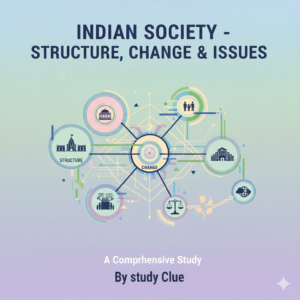
Sociology Part 2
Indian Society – Structure, Change & Issues is a comprehensive and analytical guide designed for students, educators, civil services aspirants, and anyone seeking an in-depth understanding of India’s social fabric. The book presents a clear, structured, and conceptual overview of Indian society—its historical evolution, cultural diversity, institutions, inequalities, and the complex processes of social change.
Organised into eleven carefully crafted units, the book covers the foundations of Indian society, major social institutions, colonial impact, rural and urban structures, population dynamics, gender issues, social movements, and contemporary challenges. Each unit is designed to build conceptual clarity, supported by relevant examples, theoretical perspectives, and real-world illustrations.
This work serves as a valuable resource for UPSC, State PSCs, UGC-NET, university courses in Sociology and Social Sciences, and general readers who wish to gain a deeper insight into the interactions between tradition, change, development, and emerging social issues in India.
Table of Contents
Unit 1: Indian Society – Structure & Diversity
Unit 2: Indian Social Structure – Institutions
Unit 3: Social Stratification in India
Unit 4: Impact of Colonial Rule
Unit 5: Rural & Agrarian Social Structure
Unit 6: Urban Society in India
Unit 7: Social Change in India
Unit 8: Population & Society
Unit 9: Gender & Society
Unit 10: Challenges of Social Transformation
Unit 11: Social Problems in Contemporary India
Indian Polity
Basic Indian Polity is a comprehensive, well-structured, and student-friendly resource designed to provide a clear understanding of India’s political and constitutional framework. The book offers an in-depth exploration of how the Indian political system evolved, how its democratic institutions function, and how constitutional principles guide governance at every level.
Written in simple and accessible language, the book covers a wide range of topics—from the historical background of the Indian Constitution to the functioning of Parliament, Judiciary, Federal System, Local Government, Constitutional Bodies, and important political concepts. Each chapter is enriched with factual clarity, analytical explanations, updated information, and references to significant constitutional amendments and Supreme Court judgments.
This book is especially useful for aspirants of UPSC, State PSCs, SSC, Bank, Defence, Teaching Exams, and students of Political Science, as well as for general readers interested in Indian governance. Its systematic layout ensures conceptual clarity while helping learners connect theoretical knowledge with real-world political processes.
By the end of the book, readers gain a holistic understanding of India’s political structure, governance mechanisms, constitutional vision, democratic values, and challenges in contemporary polity.
Units Included in This Book:
Unit 1: Introduction to Indian Polity
Unit 2: The Constitution of India
Unit 3: Union Government
Unit 4: State Government
Unit 5: Local Government & Rural/Urban Governance
Unit 6: Judiciary of India
Unit 7: Constitutional Bodies
Unit 8: Non-Constitutional Bodies
Unit 9: Federal System in India
Unit 10: Important Political Concepts
Unit 11: Political Parties & Election System
Unit 12: Constitutional & Political Amendments
Unit 13: Centre–State Financial Structure
Unit 14: Miscellaneous Topics (Exam-Important)
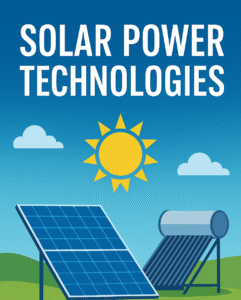
Solar Power Technology
This book provides a comprehensive overview of Solar Energy Systems, covering fundamental concepts, working principles, and practical applications. It includes detailed explanations of solar thermal systems such as solar water heaters, cookers, dryers, and lighting systems, along with their preventive maintenance procedures.
The later units focus on Solar Photovoltaic (PV) systems, including the construction and working of PV cells, series and parallel module connections, solar charge controllers, inverters, batteries, and power tracking systems. Special emphasis is placed on off-grid and grid-tied PV systems, solar-wind hybrid configurations, and real-world system layouts and specifications.
Designed especially for diploma and engineering students in Electrical and Renewable Energy disciplines, this book bridges theoretical knowledge with field-level understanding. It serves as an excellent resource for students, faculty, and professionals involved in solar energy education and installation practices.